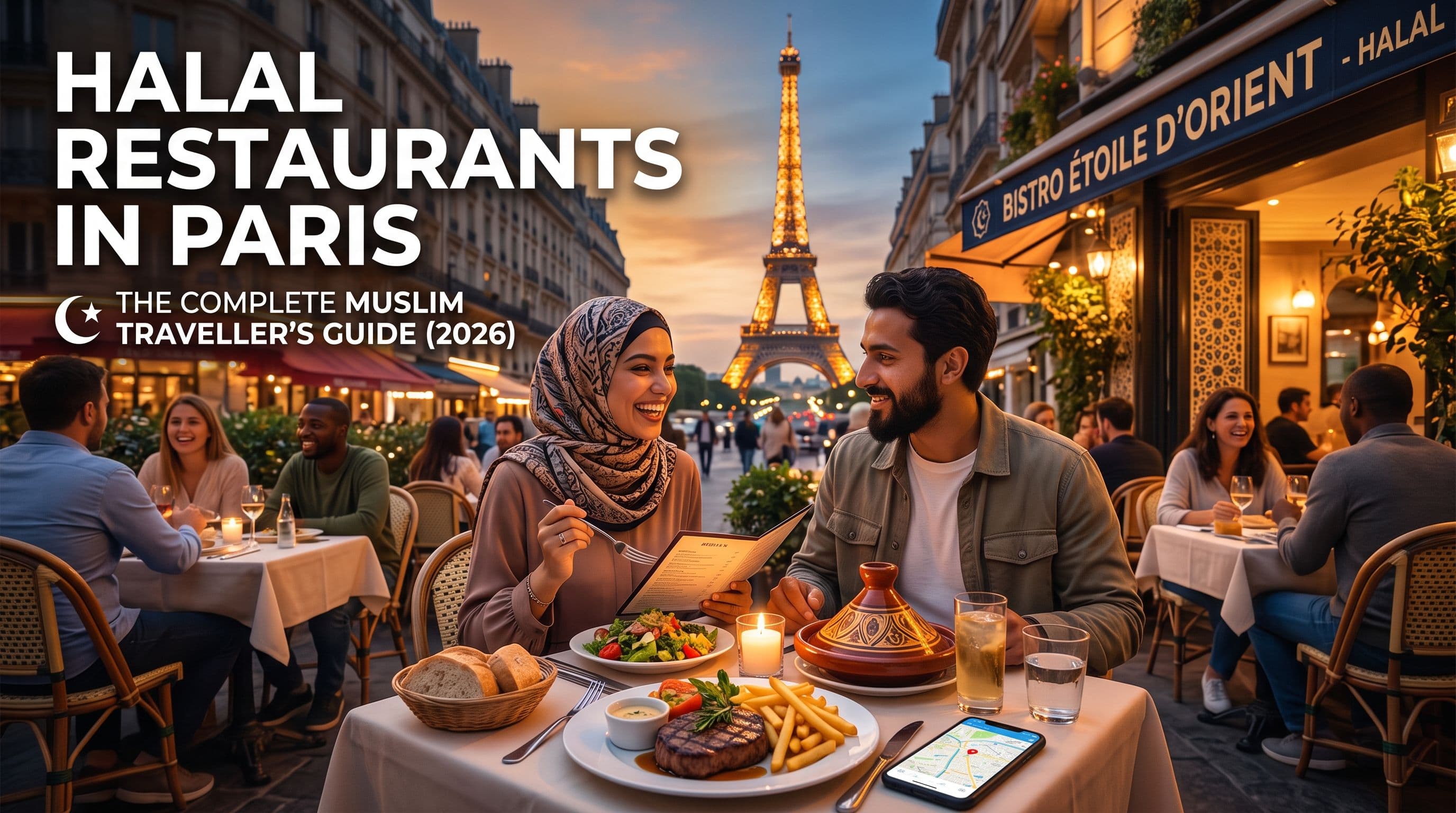
Paris surprises Muslim travellers. Most people expect the City of Light to be difficult for halal dining: expensive, French-centric, and with limited options. The reality is the opposite. France has approximately 5 million Muslim residents, one of the largest Muslim populations in Western Europe, and a significant proportion of them live in and around Paris. This means the halal food infrastructure in the French capital is genuinely excellent, diverse, and available across every price point.
The key is knowing which areas to focus on. Paris is a city of distinct quartiers, and the halal food scene is concentrated in specific neighbourhoods. Once you know where to go, eating well as a Muslim traveller in Paris becomes effortless rather than stressful.
The Best Neighbourhoods for Halal Food in Paris
Barbes-Rochechouart and Goutte d'Or (18th Arrondissement)
The 18th arrondissement, particularly the area around Barbes-Rochechouart Metro station and the Goutte d'Or neighbourhood, is the heart of North and West African Muslim life in Paris. Walking these streets feels genuinely different from tourist Paris: the atmosphere is North African, the grocery shops sell halal products from across the Maghreb, the sweet shops produce Moroccan pastries, and the restaurants serve authentic Algerian, Moroccan, and Tunisian cooking at very low prices.
What to eat here: Couscous royale (the benchmark dish to try), tagine, merguez sandwiches, Algerian brick pastry, fresh orange juice, Moroccan mint tea, and an extraordinary range of North African pastries and sweets. Prices are significantly lower than in tourist Paris; a full couscous meal with bread and salad can be under 12 euros.
Belleville (19th and 20th Arrondissements)
Belleville is one of the most genuinely multicultural areas of Paris, a neighbourhood where Chinese, North African, Turkish, and West African communities have settled alongside each other and created a food scene of unusual variety. For Muslim travellers, Belleville offers halal options from across the Muslim world: Moroccan, Tunisian, Turkish, and Pakistani restaurants all within a short walk of each other.
What to eat here: This is the area to explore if you want diversity. Turkish pide, North African couscous, Pakistani biryani, and Senegalese thieboudienne are all accessible here. The street itself has a good energy and the mix of communities makes for one of the more interesting Paris walks.
La Chapelle (10th and 18th Arrondissements)
La Chapelle has a large South Asian Muslim community, predominantly from Pakistan and Bangladesh, and several excellent halal South Asian restaurants. Rue du Faubourg Saint-Denis in the 10th arrondissement has some of the most affordable and most authentic halal Pakistani and Indian food in Paris, with several restaurants serving serious biryani and karahi in a no-frills setting. This is where Parisian Muslims come for South Asian food, which is usually a reliable quality indicator.
The Marais and Central Paris Halal Options for Tourists
For visitors based in central Paris near the major attractions, halal food is more scattered but not absent. The Marais has several certified halal restaurants. Miznon on Rue des Ecouffes serves halal-certified pita sandwiches of exceptional quality; the cauliflower and the lamb are both extraordinary, and it is enormously popular, so expect a queue at lunchtime. L'As du Fallafel on the same street is the city's most famous falafel restaurant, cash-only, halal-certified, and worth every minute of the queue.
Specific Paris Halal Restaurants Worth Booking
L'As du Fallafel (Marais) Essential
The most famous falafel sandwich in Paris and genuinely worth the reputation. The falafel itself is crisp outside, fluffy inside, and served in a warm pita with outstanding fried aubergine, hummus, and pickles. The queue moves quickly. Cash only. Halal certified. Under 8 euros for a large sandwich that will fill you for hours. One of the great cheap eats in Europe.
La Taverne du Nil (2nd Arrondissement) Egyptian-Lebanese
A well-established halal restaurant in the 2nd arrondissement with an Egyptian and Lebanese menu. The setting is relaxed and comfortable for longer meals. The mezze selection is excellent, and the grills are reliable. Good for a proper sit-down halal dinner in a central location without going to the outer arrondissements. Book ahead on weekends.
Liza (Near Opera) — Upscale Lebanese
Liza is one of Paris's best Lebanese restaurants at any certification status, and it is halal certified. The food is serious — modern Lebanese cooking with excellent produce and precise technique. The kibbeh nayeh (when in season), the fattoush, and the grilled meats are all excellent. For a special occasion halal dinner in Paris, this is a strong choice. Prices are moderate to high by Lebanese standards, reasonable for Paris.
The Grande Mosquee de Paris — More Than a Prayer Space
The Grande Mosquee de Paris, built in 1926 in the 5th arrondissement near the Jardin des Plantes, is one of the most beautiful buildings in Paris and an important Muslim institution in France. The mosque is open to non-Muslim visitors during specific hours. What many visitors do not know is that the mosque has an excellent attached North African restaurant and a tea room that serves mint tea and Moroccan pastries in a beautiful tiled courtyard setting.
The tea room is open daily, does not require any religious affiliation to use, and serves some of the best Moroccan mint tea in Paris in an extraordinarily atmospheric setting. The restaurant attached to the mosque serves a full North African menu and is halal certified. Visit for tea, stay for a meal, and take time to look at the mosque's remarkable Moorish architecture one of the great underrated experiences in Paris.
Prayer Facilities in Paris
Paris has mosques throughout the city, though coverage is uneven compared to London. The Grande Mosquee de Paris is the most prominent. The Institut Musulman and several community mosques in the outer arrondissements serve the large Muslim population. For tourists in central Paris, the mosque facilities are less immediately accessible than in Muslim-majority cities, so carrying a travel prayer mat is important.
Major Paris attractions including the Eiffel Tower area, the Louvre, and Versailles do not have dedicated prayer rooms. Plan prayer times around your sightseeing schedule. The Louvre's Islamic Art wing, which houses one of the world's greatest collections, is a genuinely moving space for Muslim visitors and worth two to three hours of unhurried time.
Important Notes for Muslim Travellers in France
France has specific laws regarding religious expression in public spaces that Muslim visitors should be aware of. Face coverings are prohibited by law in French public spaces. This does not apply to the niqab in private spaces or to hijab, which remains legal and is widely worn throughout Paris without issue. The law specifically targets face coverings in public, not head coverings.
In practice, Paris is a large, cosmopolitan city where Muslim women in hijab face very little day-to-day friction. The outer arrondissements with large Muslim communities feel entirely normal for observant Muslim visitors. The tourist-heavy central areas are equally comfortable.
Final Thoughts
Paris rewards Muslim travellers who know where to go. The city's extraordinary museums, architecture, and cultural life are accessible to everyone, and the halal food scene in the outer arrondissements is genuinely among the best in Europe. Go to Barbes for your evening meal, visit the Grande Mosquee for afternoon tea, and queue for falafel at L'As du Fallafel for lunch. You will eat very well in Paris as a Muslim traveller. The key is simply knowing which streets to walk down.